
Cognel for startup programs.
Every founder in the cohort gets your best advisor's process.
Founders face high-stakes decisions with little time and no experience of the territory. Expert attention is the scarcest thing a programme has, and it goes to whoever asks first.
Cognel runs the same structured reasoning for every founder, on demand. Your team reviews the result instead of re-establishing the context. It suits technology and deep-tech teams in particular, where the product is complex enough that customer and market reasoning is easy to postpone.
Typical founder gaps.
We asked an accelerator, an incubator and an early-stage investor where founders come unstuck. The answers matched. Founders rarely fail for lack of information. They fail on the reasoning behind the decisions that matter most. Three gaps came back every time, and each has a Guide built for it.
Understanding the customer
All three pointed here first. Founders talk to the wrong people and hear what confirms what they already believe. Deep-tech teams build first and look for a buyer afterwards.
MDMV: customer discovery
Starts where a technology startup actually is, with an innovation and no buyer, and finds the customer before the wrong one is built for.
Understanding investors
The deck is seldom the problem. Founders misjudge how investors weigh a company, what capital efficiency means in practice, and which milestones are realistic.
Fundraising and investor thinking
Not pitch coaching. How investors actually judge a company, and the business case behind the round. We would shape it with partner programmes.
Deciding under uncertainty
Scenarios, a Plan B that exists on paper, affordable loss, milestones. Without a method, founders commit to the first option that feels survivable.
Strategy and scenarios
Option analysis, scenario planning and negotiation preparation, so assumptions are named before the commitment rather than after it.
MDMV, in more detail.
MDMV is the Guide most cohorts start with, and the one Cognel was built around. It takes a founder from an innovation with no named buyer to a first market chosen on stated grounds. Segments are described, compared against criteria the founder sets, and the ones that lose are recorded with the reason they lost.
It is the Guide where the difference is easiest to see. A founder who has been through it can say which customer they are for, which they are not, and what would have to be true for that to change.
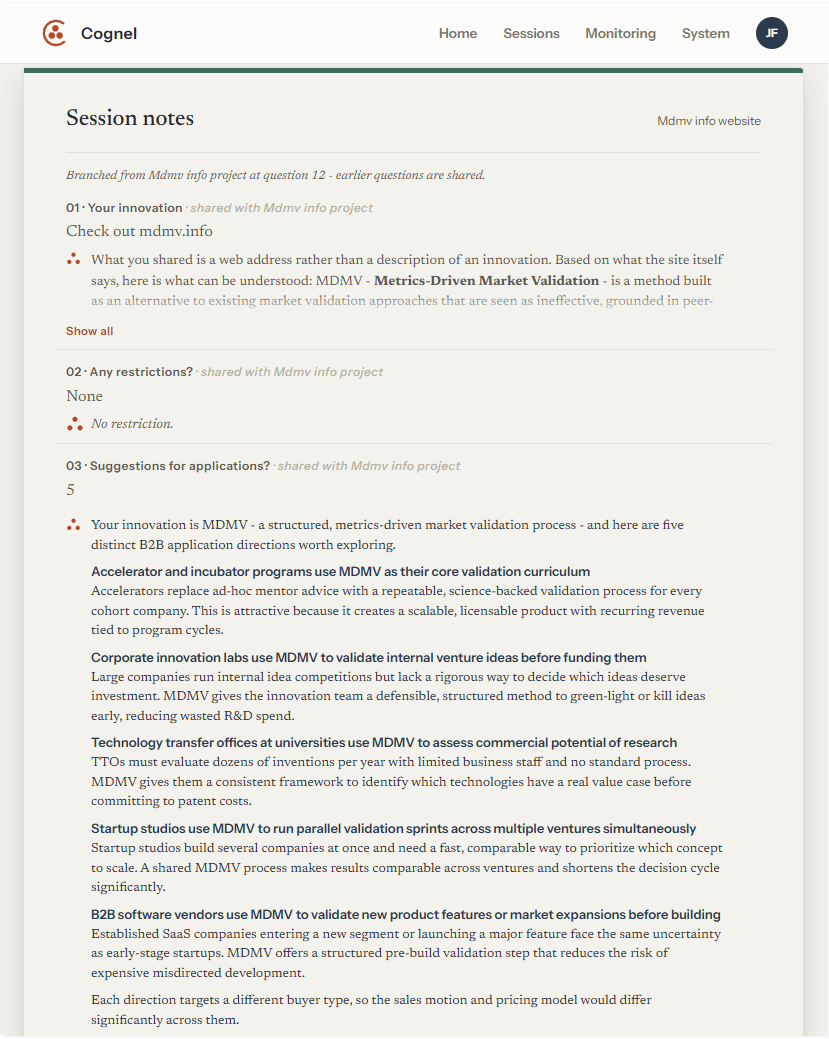
Session notes from an MDMV run. Each question, the founder's answer, and the application directions the Guide worked out with them, one buyer type at a time.
Reasoning your team can compare.
Every founder runs the same expert-designed process, whatever their domain, background or stage. What comes out is not a narrative deck. It is a structured record, aligned question by question, which means a coach can read across the cohort, see where an assumption is thin, and spend the session there.
The same holds within a single founder's work. Changing one answer spins off a parallel scenario, so the alternatives sit side by side rather than being argued from memory. Mentor time goes to strategy instead of context.
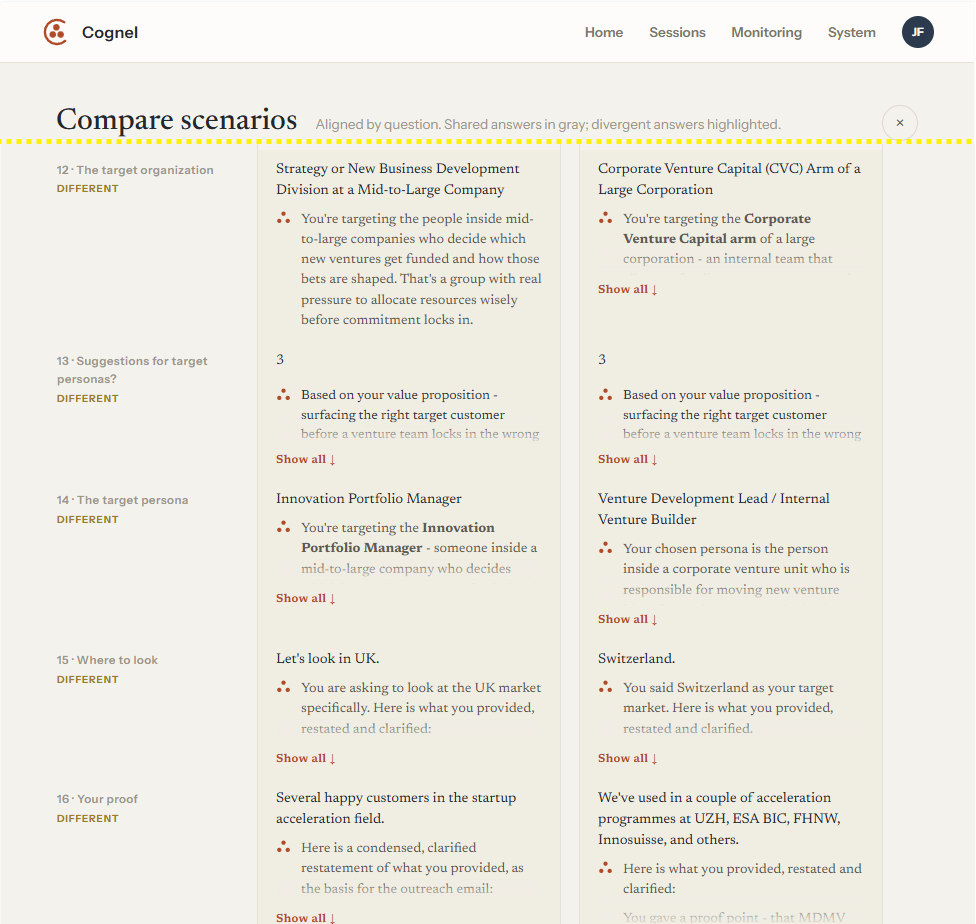
Two MDMV scenarios of the same innovation, aligned by question. One targets a business development division, the other a corporate venture arm, and the answers diverge from question 12 onward.
Founders find their feet faster.
The world a founder has to operate in is foreign at the start. Customers behave in ways the technology does not predict, investors judge on grounds nobody explains, and some choices cannot be taken back. The founders a programme values most are the ones who learn to navigate that quickly.
Reasoning through a decision the way an experienced advisor would is how that gets internalised. Founders arrive at sessions with something to build on rather than basics to re-explain, and they leave the programme with the habit of deciding systematically.
Tell us about your cohort.
Thirty minutes. How many founders, what stage, which decisions keep coming back to your coaches. We say whether Cognel fits, and show you a session end to end. Cohort licences and onboarding for the coaching team are part of the package.
Book a walkthrough
Jan Fülscher

Catalina Ortiz de la Peña Svec