
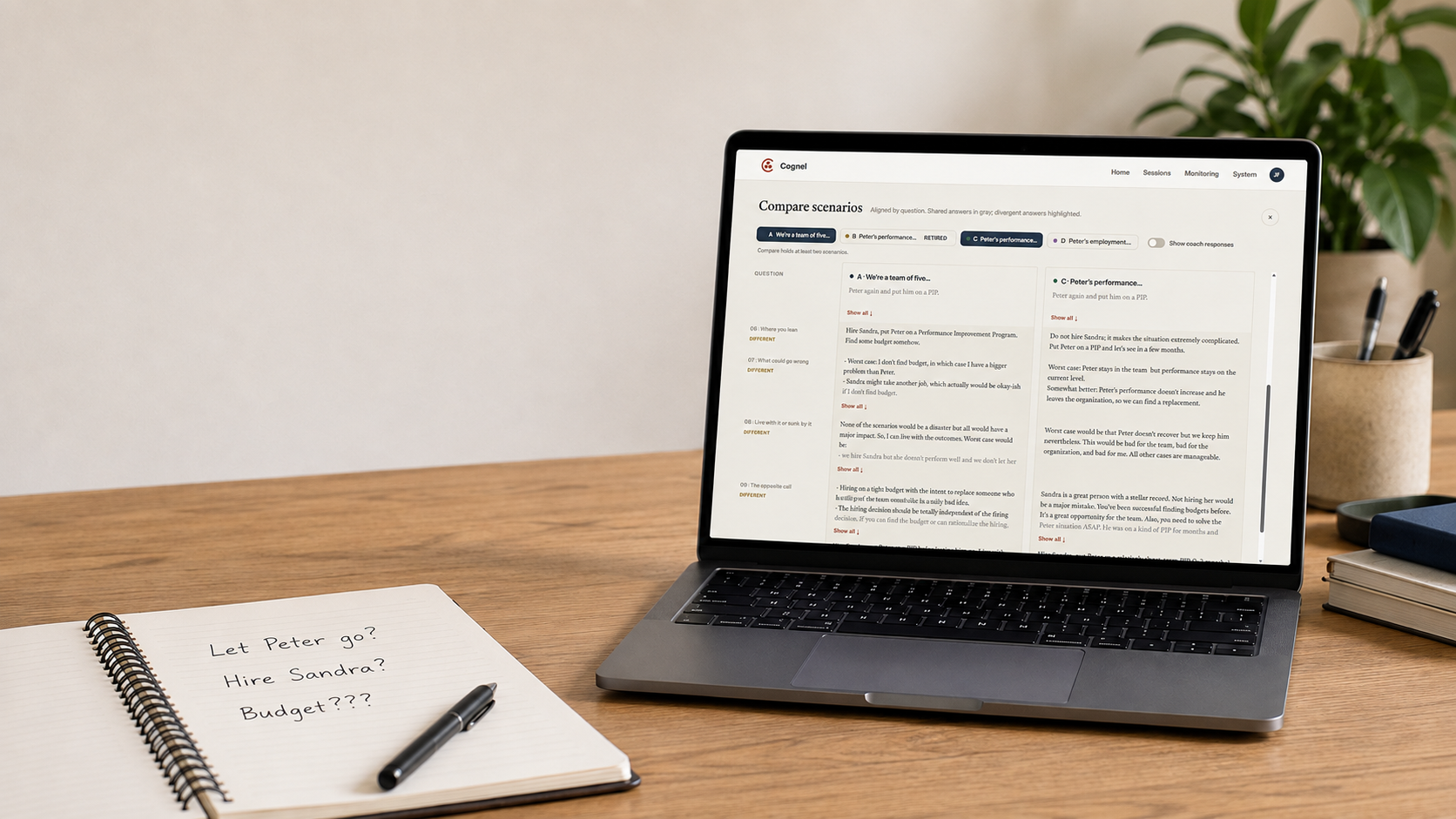
Half of business decisions fail.*
The decision sits with you for weeks. Each option costs something, the case for each one is arguable, and nobody else can make it.
Most of the time only one option is ever seriously considered. Intuition is fast, and in familiar territory it is usually right. These decisions are not familiar territory. Long before AI, judgement was the weak point.
AI makes it easier to arrive at an answer than to work one out. It comes back instantly and fluently, and committing to it is easier than doubting it. What remains afterwards is a chat transcript, which is not a decision record, so the decision cannot be defended to a board, an investor, a regulator, or to yourself.
In Cognel, you do the reasoning. The Guide provides the method.
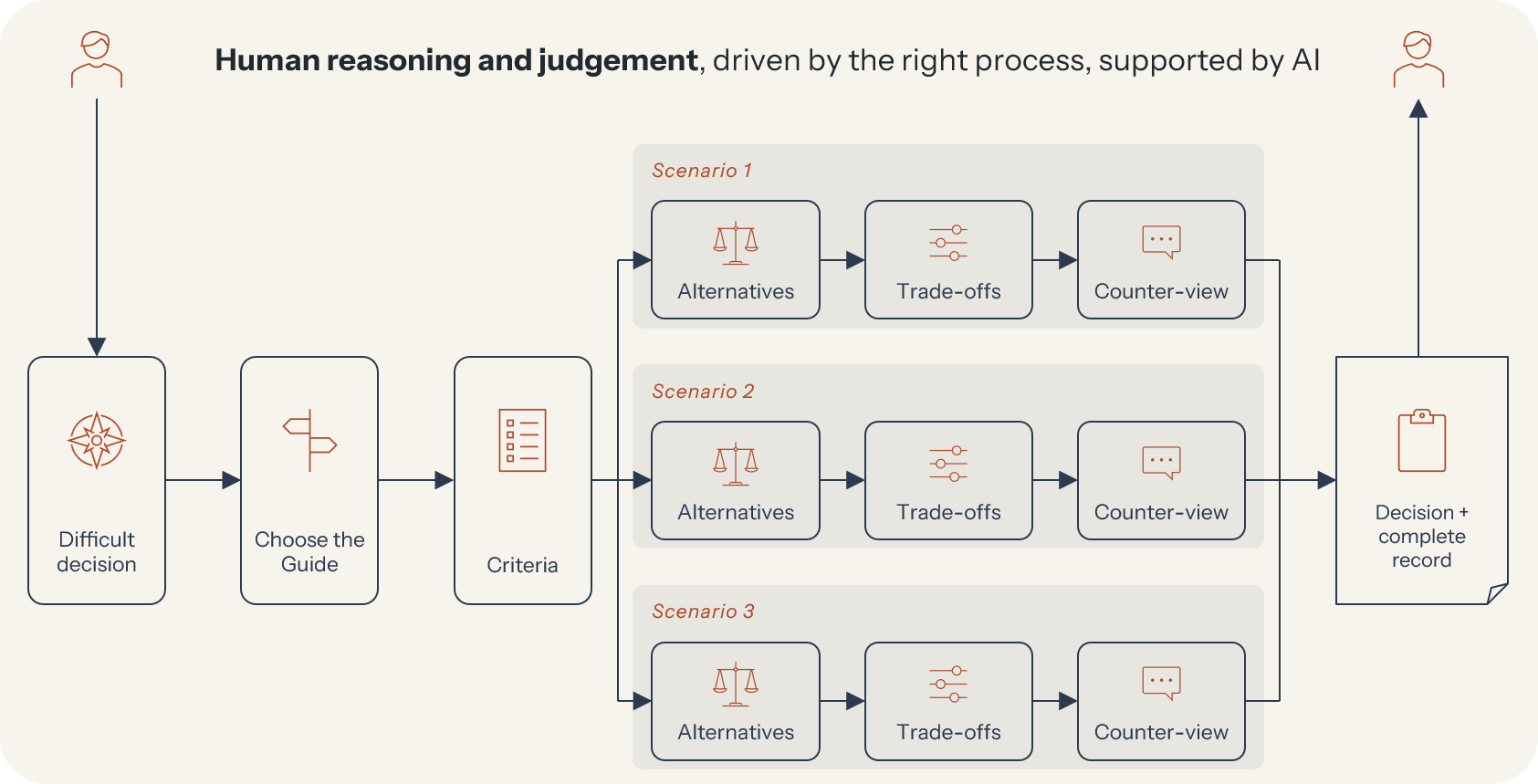
Each Guide takes an explicit decision method and runs it as a guided workflow. You work in steps. Each step asks one question, and you write the answer in your own words. The model reads what you wrote, adds insights and alternative views, and suggests options where creativity is needed. It does not write the decision.
A Guide for each kind of decision.
Cognel Guides are anchored in explicit methods suited to the problem they address, and take you through their steps in order, so nothing required is skipped.
Guide Finder points you to the right Guide before any work starts, so the method matches the decision rather than the other way round.
Some examples for Guides Cognel provides:
- Root Cause Analysis for getting to the bottom of a problem
- Effectuation for planning under extreme uncertainty
- Harvard Negotiation for a negotiation where the relationship has to survive the outcome
- MDMV for choosing which market to serve first
The Guide sets the method. Alternatives, trade-offs and counter-views are worked through across scenarios that run in parallel, three of them here, and the record comes out complete.
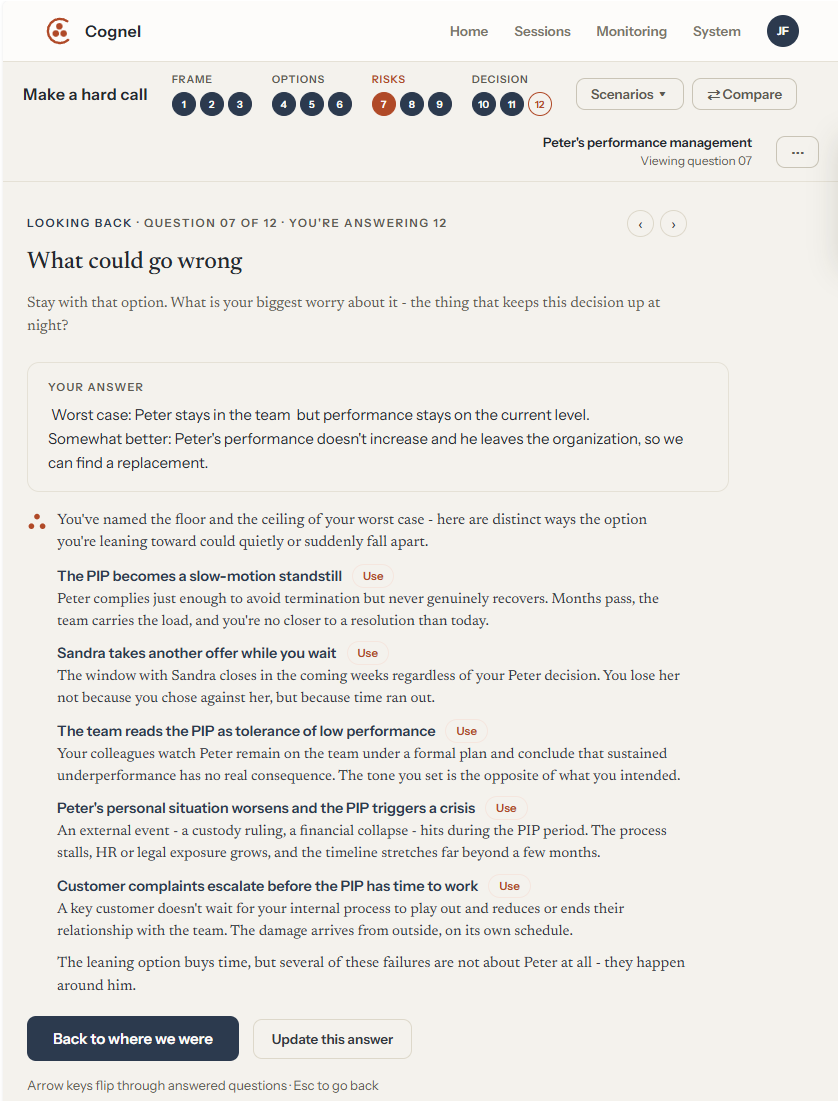
Question 7 of 12 in a real decision. The answer is the user's own. What follows are distinct ways it could fall apart, each one available to carry forward.
Studied at the University of Zurich.
A study at the chair of Prof. Dr. Eva Bittner at the University of Zurich evaluated Cognel and found that it fostered productive engagement rather than cognitive offloading. It is currently under review. Two further studies, at the chair of Prof. Dr. Gerhard Schwabe at the same university, led to results that influenced the architecture and the interaction design.
Who works with Cognel
Consultants and coaches use Cognel with their own clients, one decision at a time. Startup programmes and investors use it across a whole cohort, from customer discovery to strategic choices, which gives every founder the same standard of reasoning and comparable outputs to coach against.
There is a package for programmes, with cohort licences and onboarding for the coaching team. For startup programmes.
Qualifying university studies receive free licences, access to the methodology and custom Guides where feasible. For research.

The same three questions, answered.
Tell us the decision you are facing.
Thirty minutes. We say whether Cognel fits what you are dealing with, and show you a session end to end.
Book a walkthrough
Jan Fülscher

Catalina Ortiz de la Peña Svec